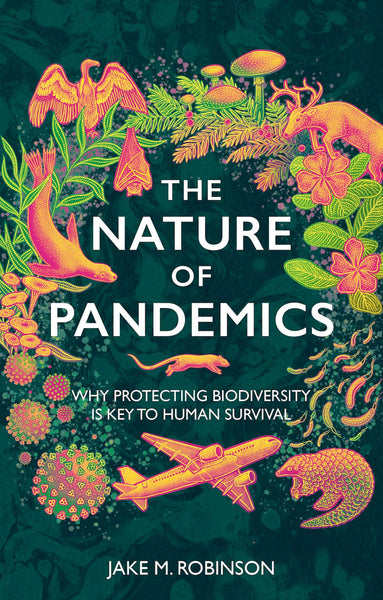





Jake Robinson talks to us about The Nature of Pandemics.

As a microbial and restoration ecologist with a PhD in the environment-microbiome-health axis, your research is highly interdisciplinary. What led you to write The Nature of Pandemics?
The book began with a simple but confronting realisation that understanding pandemics demands an interdisciplinary lens. They are not only medical crises. They are ecological events shaped by stressed ecosystems, shifting wildlife dynamics, global trade, cultural behaviours and the invisible microbiomes that connect all living systems. Working across microbial ecology, restoration science and One Health, I kept seeing how deeply ecological disruption underpins pandemic emergence.
I also wanted to lift the focus beyond human-centred narratives and draw attention to wildlife health, our own cognitive blind spots and the solutions that become visible when we view outbreaks as system-wide phenomena. During the COVID lockdowns, while quarantined in my home village of Eyam (in the Peak District, UK), a place known for its extraordinary response to the 1665 plague, I began drafting early ideas. It felt uncanny, as if past and present were folding together, urging me to explore how ecological understanding might help us prevent the next pandemic rather than simply endure it.
What was the biggest challenge you faced whilst writing the book?
One unexpected challenge was writing about microbes primarily as pathogens. Most of my own research focuses on the health-promoting (or ‘salutogenic’) roles of environmental microbes, so shifting into the territory of harm felt counterintuitive at first, despite having an early background in parasitology… But that tension is central to the One Health story. Microbes are vital to life; we depend on them. Yet under the wrong ecological conditions, the same microbial worlds can spill into disease. Holding those two truths at once was tricky, but necessary.
It was also, at times, emotionally confronting. Much of the public conversation focuses on human suffering, but millions of more-than-human lives – bats, amphibians, birds, primates, plants – are lost in pandemics of sorts (sometimes called ‘panzootics’) that barely register in the media. Sitting with that scale of loss, while trying to write in a constructive and hopeful way, was harder than I expected. But it reinforced why prevention matters, and why we need to design systems that protect all species, not just our own.
The book uses historical case studies, such as the bubonic plague in Eyam, to inform modern challenges. What do historical outbreaks teach us about pandemic dynamics that remains relevant to the threats we face today?
History shows us that pandemics often follow predictable pathways when societies are stressed – by inequality, environmental disruption, or political fragmentation. Eyam’s story illustrates how collective action and behavioural change can dramatically alter disease trajectories. Medieval outbreaks also reveal the dangers of misinformation (for perhaps different reasons than today), stigma and fear, which shaped patterns of spread just as they did during COVID-19. Most importantly, historical outbreaks remind us that humans are embedded in ecological systems. Over time, many of us have drifted away from a sense of ‘oneness’ with (the rest of) nature. That weakening connection – socially, culturally and even biologically – shapes the conditions that allow pandemics to emerge, and it erodes our resilience in ways we rarely recognise. The past is a vital lens that helps us understand modern vulnerabilities.
What was the most surprising thing that you learnt whilst working on the book?
I was struck by how many pandemics begin long before the first human infection. Years – sometimes decades – of ecological disruption set the stage: deforestation, intensive farming, wildlife exploitation, pollution, globalisation, soil degradation, and microbial shifts in the environment… The sheer number of wildlife species now being struck down by diseases that humans amplify is genuinely shocking. Once you start looking, you see how many more-than-human lives are being lost, without headlines or help.
I was also surprised by how deeply our cognitive biases shape our responses. Humans struggle to react to slow-burning, systemic threats, even when the evidence is overwhelming. But the amazingly innovative work many scientists are doing to protect humans and wildlife is also surprising, but comforting.
I suspect one of the most surprising realisations for many will be how interconnected everything is. Microbes in soils, stress physiology in wildlife, trade networks, poverty, governance and even cultural beliefs. A pathogen is only one piece of the story.
The Nature of Pandemics reframes the current crisis, arguing that pandemics are fundamentally ecological crises that require ecological solutions. Why is this shift in perspective from a purely medical or public health focus so vital for preventing the next global outbreak?
If we treat pandemics solely as medical problems, we will always arrive too late. It’s reactive, rather than proactive. By the time a pathogen reaches hospitals, the ecological conditions that enabled spillover have already solidified. A One Health approach forces us to confront the system – habitat destruction, biodiversity loss, agricultural intensification, air quality, microbial exposure, and social inequity, etc. – that shapes risk.
This perspective widens the solution space. Restoring ecosystems, improving urban biodiversity, transforming agriculture, supporting healthy soil and microbiomes, regulating wildlife trade, designing equitable public health systems, and addressing climate-driven stressors. Ecological crises require ecological solutions – not only biomedical ones.
Who is the target audience for the book and what do you hope they will take away from reading it?
The book is written in an engaging style for anyone who wants to understand pandemics at their root – from environmental professionals and policymakers to clinicians, educators, and curious readers. It’s also for students exploring One Health, planetary health or environmental science. I hope that readers come away recognising that preventing pandemics is about transforming the systems that create risk in the first place. If people feel empowered rather than overwhelmed, and recognise that healthier ecosystems mean healthier societies, the book has done its job.
Learn more about The Nature of Pandemics here.