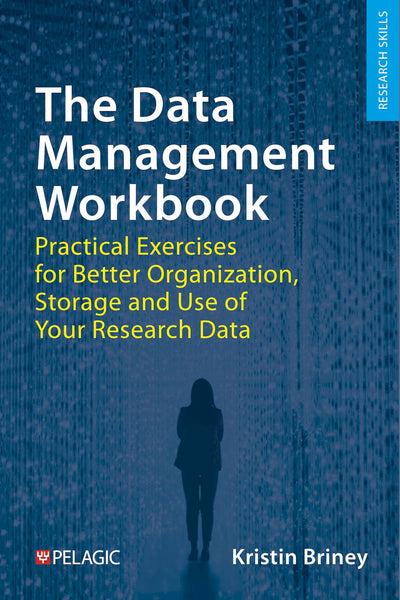





Kristin Briney talks to us about The Data Management Workbook.
Could you tell us a little about your background and your interest in data management?
I’m a chemist by training. I finished my PhD in physical chemistry and realized that, while I love science, I found the data aspects of doing my research to be the most interesting – and frustrating – parts of the process for me. Not long after finishing my PhD, I learned that a lot of the data disasters I experienced in my research were actually preventable through good data management. I decided to go to library school and become an expert in data management, and I haven’t looked back.
What made you decide to write The Data Management Workbook?
I regularly teach data management fundamentals and have already written the introductory book on data management, Data Management for Researchers (also published by Pelagic). The challenge I now encounter is how to bridge from a data management lecture or a section of my first book and integrate data management techniques into real-life research workflows. That’s what the point of The Data Management Workbook is: to hold your hand and gently guide you toward customized data management strategies that work in your research.
What was the biggest challenge you faced whilst working on the book?
I think my biggest challenge was distilling data management strategies into concrete steps while also allowing for customization. Take the example of file naming conventions: typical data management guidance tells you why they matter and the rules for what makes a good naming convention. This book, instead, gives you eight actionable steps for creating a naming convention that is tailored to your research; different researchers working through the eight steps are likely to come up with completely different naming systems (and that’s okay)! It was a challenge to identify specific data management tasks that could be reduced to exercises with this balance of reproducibility and customization.
Who is the target audience for The Data Management Workbook?
This book is for anyone who wants to manage their data better. This is really a book about doing data management (by actively working through the exercises in the book) rather than understanding the why’s and what’s of data management. The book is both for people who want to do data management for the first time as well as people who want to improve their existing data management.
The book builds on the foundations of your previous book, Data Management for Researchers. Do readers need to be familiar with this text to benefit from The Data Management Workbook?
I don’t think it’s necessary to read Data Management for Researchers before going through The Data Management Workbook. I do think a new reader will want to have some sense of why data management is important (or important enough to go through a whole book of data management exercises), but I tried to provide enough context in The Data Management Workbook for new readers to understand each activity on its own.
What advice would you give someone who is just starting to develop skills in this area?
My standard advice for anyone new to data management is to implement one strategy at a time until it’s routine. For example, you might start by making sure you have a reliable backup system. Once you are comfortable with that, you might implement a file naming scheme. After naming your files consistently becomes routine, you can try another data management strategy. The idea is to slowly integrate better practices into your research to the point where good data management becomes habit. There are obviously lots of exercises in this workbook but it’s less overwhelming to approach data management one strategy at a time.
Learn more about The Data Management Workbook here.