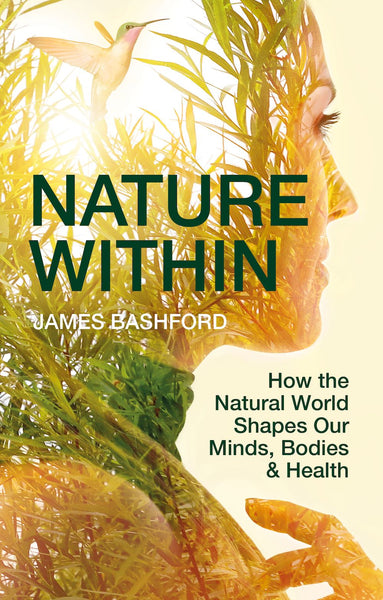





James Bashford talks to us about Nature Within.

Could you tell us a little about your background and where your interest in the world of neuroscience began?
I grew up in the market town of Bishop’s Stortford in Hertfordshire. To be honest, I have never strayed too far from home for too long; I studied medicine in Cambridge, worked and lived in London for the latter half of my 20s, and have lived for the past eight years with my wife and two daughters in Stansted Mountfitchet, about four miles from where I grew up. Apart from a brief spell as a teenager when I wanted to study mathematics at university, I remember always having my heart set on becoming a doctor. The brain in particular had always fascinated me; it seemed to be the organ with the least known about it. And I therefore thought it was an area in which I could make the most impact. In fact, this didn’t start with research, or treating patients with neurological symptoms; it began with teaching. During my senior years at medical school, I had the opportunity to give tutorials to medical students just starting out. I chose neuroscience as my favoured topic. And I relished finding creative ways to break down the complexity of how our brains and nerves work, so that others could become excited by it, too. Plus, I got paid for it! Which, as a student working in Pizza Hut during my holidays to make ends meet, was a real bonus. And so I soon decided to make neuroscience my longterm career. Remarkably, I still get paid for studying a topic I am endlessly fascinated by.
When did your interest in clinical neuroscience begin to merge with your passion for the natural world? Was there a 'watershed' moment that inspired you to write Nature Within?
In the field of clinical neuroscience, we spend nearly all our time thinking about how the brain and its many connections work. Or, in the case of neurological disease, how this system of nerve cells stops working as well as it should. In learning about all this, I have come to appreciate just how complex the brain is, almost infinitely so. And yet, this infinitely complex structure is made time and time again in every one of us. From just one fertilised egg emerges this interwoven mass of 170 billion cells that we call the brain (not forgetting the other 30 trillion or so cells that make up the rest of the body). And we demand so much from our brains, don’t we? We expect it to focus, sense, remember, communicate, love, to name a few of our most fundamental brain outputs. What’s more is we want each of these outputs to work perfectly exactly when we want it, over far longer lifespans than at any point in our species’ evolutionary past. But when I really considered what allows our brains to deliver on these demands, it was the core natural processes deep within those 170 billions cells that I kept coming back to – and it suddenly seemed so obvious to me that our brains must still require the same guidance that guided them into being in the first place. How else could they maintain their cellular health! Yes, my own reconnection with the natural world through moth photography has provided me with first-hand insight, but it was a need to convey the inner workings of our brains that compelled me to write Nature Within. This pursuit has helped to simplify the brain’s unknowable complexity for me. And I hope readers get a sense of that, too.
Your background as a neurologist and clinical academic grounded the book in up-to-date neuroscience. What was the most surprising thing you learnt whilst conducting research for the book?
The revelation that stands out most to me concerns human vision. As a neurologist, I hear about lots of different symptoms from patients, and some of those are visual complaints, including blurriness, flashing lights, duplication of objects or even complete loss of vision. But usually these symptoms have come on quite recently and we can have a reasonable go at suggesting (and hopefully treating) a neurological cause. But when I learnt about how our children’s visual systems are maturing differently in the modern world, it both fascinated and worried me. It turns out something sinister is at play as our kids view vids and our teens watch screens, and it’s going on right under our noses. When I found out that this lack of natural visual stimuli before adulthood is physically changing the shapes of our eyes, it bowled me over. I never thought I would find such a tangible example of the detrimental effects of our modern natural disconnection. And yet, here it was. Admittedly, the visual system is just doing what comes naturally to it in the face of a stimulation overload at close proximity – like any biological system, it adapts to ease the work it has to do. But it massively overcompensates, and what’s left is a visual system that can no longer focus on the faraway objects. Consequently, it can no longer see the rich variety of the natural world, simply because it has not been nurtured in the way the eyes and brain expect. And because of all this, our species is set to face a pandemic of nearsightedness in decades to come.
Nature Within argues that "Reconnecting with Nature is the most important public health intervention of our time". That's a powerful statement. Why do you feel this is a more critical intervention than, say, diet, exercise, or smoking cessation?
Let me start by clarifying that all the things you mention (diet, exercise and smoking cessation) are vitally important aspects of healthy living. There’s no doubt that at the individual level it’s a full package of lifestyle optimisation that has the greatest effect on one’s health. But public health extends far beyond the individual. The most inclusive public health strategies zoom out as far as you can go and look collectively at the global population, not only affecting those alive now but those who are yet to be. And that’s where I believe our reconnection with Nature comes in. It affects absolutely everyone, as we are all part of the natural world. And therefore this is why I don’t think it’s an exaggeration to say it’s the most important. But it doesn’t discount any of the other fundamentally vital public health interventions that have proven their benefits when it comes to improving quality of life and human longevity: provision of clean water, sanitation, vaccination, etc… Reconnecting with Nature is inclusive of all these things, and more. Yes, at one level, reconnecting with Nature is about regularly engaging with the forgotten natural neighbours on our doorsteps, but, on another level, it’s about recognising all the ‘unnatural’ things we are exposed to in our modern, sprawling, connected, hyperactive, profit-hungry world. Whether it’s the emerging harmful effects of the ultra-processed foods on our shelves or the so-called forever chemicals that make up their packaging, or the more established threats posed by our planet’s rapidly changing climate and dwindling ecosystems, all these things, in my view, boil down to a warped and vaunted understanding of our species’ position within Nature. Nature Within attempts to get us thinking and talking about this, so that we can shift ourselves back to a healthier, more natural state.
Who is the target audience for Nature Within, and what do you hope readers will take away from the experience?
This will sound incredibly clichéd (the truest things often do), but what I have tried to do in Nature Within is walk readers along a path that I myself have only recently discovered. Most of the analogies and stories I share in the book were largely new to me when I wrote them, which I hope keeps the content fresh and engaging. I make it clear that when I cover topics such as the Earth’s jet streams or plate tectonics I am certainly no expert. Even when it comes to explaining more biological concepts, such as the leading theory driving skin colour variation among modern humans, I can assure you that these details were not part of my curriculum at medical school. Throughout the book, therefore, I have tried to layer my explanations, assuming no prior knowledge of any given subject and thereby improving its accessibility to any reader with a curious mind (whatever their background). That’s not to say there aren’t some unavoidably challenging sections, ones that dig down into questions that do not currently have (and may likely never have) a clear answer: How did life begin? Why are we not tackling the climate crisis quickly enough? Of course, all I can do in these instances is provide my own twopennyworth, hoping that it might stimulate or reawaken fresh avenues of thought. But there are also some facts in the book that offer more tangible takeaways, including the fact that we would currently need 1.8 Earths to sustainably regenerate the energy we use globally; or that all the uncoiled DNA inside your own cells would stretch to the Sun and back 20 times over! Overall, I would love it if readers are fascinated enough by just 1 or 2 ideas within the book that they go on and discuss them with their family, friends and colleagues. If that happens, that’s job done as far as I’m concerned!
Now that the book is finished, has the process of researching and writing Nature Within changed your personal day-to-day relationship with the natural world?
Yes, absolutely! My friends and family, particularly my wife Suzi, laugh when I bring up something from the book in everyday conversation. I do this not because I’m trying to settle a debate but because I’ve been living and breathing these ideas for some time now. And it’s often just what pops up in my mind. It’s even got to the stage where all I have to say is ‘Chapter 5’ or ‘Chapter 8’ with a wry smile and a gentle jab of the finger, and they roll their eyes and swiftly move the conversation on. ‘It’s become your Bible,’ they jest. And while I wouldn’t go that far, I won’t deny that there are many things I learnt while writing and editing Nature Within that I am still trying to implement in my own life. When it comes to renaturalising our senses on a daily basis, there are certainly times when the wind is howling or it’s unpleasantly cold outside and I wonder if a stroll to the nearby Nature reserve will be worth it. What I’ve found is it always is! I’ve also learned the value of appreciating my local patch – after all, familiarity brings with it a keener eye for the minutiae, even if it can often be perceived as a bit too humdrum. Plus, I now take my camera everywhere, ready to capture the next scarce species that crosses my path or, far more likely, a familiar species in a new light.
Order your copy of Nature Within here.