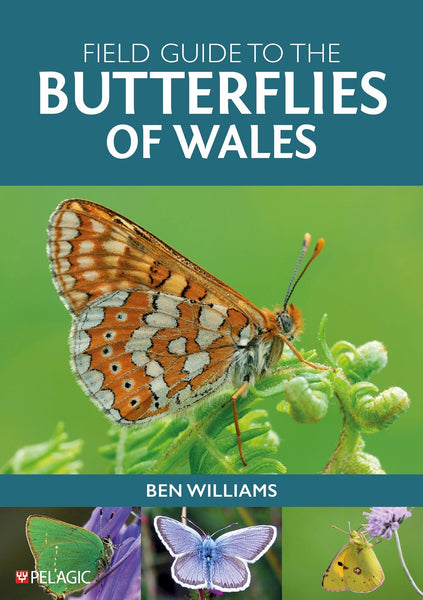





Ben Williams talks to us about Field Guide to the Butterflies of Wales.
You’ve worked extensively in coastal conservation, river projects, and habitat management. What inspired you to channel your expertise into writing a Field Guide to the Butterflies of Wales?
Apart from carrying out various surveys on rivers; I encouraged local groups to adopt areas of rivers and their surroundings with the aim of improving that environment. It wasn't all litter-picking and dragging rubbish out of the rivers. I encouraged them to look at the wildlife as well and I would point out interesting species. Many followed my lifelong interest in butterflies. In 2008 I wrote a booklet on 'Butterflies of Rhondda Cynon Taff' and it was printed by the local University. It was a giveaway book; a 'freebee' and we gave them away at environmental events. They proved to be very popular. I came to believe that ordinary Joe Soap would not buy a book on Butterflies but give him one and he might read and take an interest, and this was especially true of children. On that project I found it very difficult to get funding and this led me to write ' Field Guide to the Butterflies of Wales'. Ironically, it was easier to get published than finding funding for free booklets.
The guide covers all 44 butterfly species present in Wales. Which of the species was the most elusive or challenging for you to track down and document for this book?
Of all the species I have photographed for this book, the Hairstreaks were the hardest. They were difficult to find and when found difficult to photograph. I spent days working out the best time of day and place to be to get a picture. Indeed, on one occasion I was looking for White Letter Hairstreaks and looking at Wych Elm. My son received a message from a friend (who worked for the NHS) ' Hi Dave, I have just seen a man in camouflage gear staring at a bush 3 yards in front of him through binoculars. It was your father!!!' I replied 'I feel better now. No need for the straitjacket '. That's what happens when you look for Hairstreaks.

White Letter Hairstreak © Ben Williams
Beyond simple identification, you include detailed distribution maps and a look at rare migrants. What was your research and data-gathering process like to ensure these maps were as accurate and practical as possible?
The areas I have identified in the book are based on personal knowledge from surveys, historical records and information passed on from like-minded friends. They are guides and it is possible that the species concerned may be found in other places. As I have said, butterflies are under recorded and the best example I can think of are Essex Skippers. Most distribution maps, I have seen, don't show them in Wales but myself and others have found them along the South Wales coastal areas. From Newport to the Gower Peninsula.
The book features more than 120 stunning photographs. Do you have a favourite photography memory from your time in the field?
The Admirals are such stunning butterflies. One day I was trying to find White Admirals in the Wye Valley. I saw them but could not get close enough to get any pictures. I decided to call it day and go home and went back to my car. Whilst getting ready to leave a beautiful female (butterfly) came down from the trees and fed on some bramble flowers beside the car. Those are the pictures displayed in the book, a truly memorable moment.

White Admiral © Ben Williams
You emphasize that butterflies are excellent indicator species—that when they dwindle, it's a clear sign that something is wrong. What do the current butterfly populations tell us about the health of the Welsh environment right now?
For all the wildlife in Wales I think the situation is DIRE. Most of our SSSIs and protected sites have not been inspected by the organisation that is charged to do so; the National Resources Wales. I believe there is too much political interference and indifference to problems in our environment. It is a subject that makes me mad at the moment.

Clouded Yellow © Ben Williams
For readers who finish your book and want to do more than just watch butterflies, what are a few practical things they can do in their own gardens or local communities to help protect these essential pollinators?
To attract butterflies into the garden I would recommend planting wild flowers, however some of these can be invasive and to combat this I would recommend planting them in pots.
· Birds Foot Trefoil ( Lotus corniculatus ) is excellent, not only do the flowers supply nectar but the caterpillars of the Common Blue feeds on it as well.
· All the Clovers are good nectar sources.
· Common Valerian (Valeria officionalis) is a very good source of nectar for the early summer and attracts many species. If cut back just after the first flowering it will flower again later in the summer. It can be very invasive.
· Devils Bit Scabious (Succisa pratensis) is a late flowering plant. It attracts a large number of butterflies. It also supplies seeds for finches and mice in the Autumn.
· Water Mint (Mentha aquatica) is another late flowering plant and is better planted in the margins of a pond. It attracts many species of butterfly but can be invasive.
· Dandelions (Taraxacum officinale) They flower early and supply nectar for early butterflies such as Brimstone, Orange Tips and Green Veined Whites. They also supply the first fresh seed of the year for Finches, Voles and Mice.
· Ivy (Hedera helix) This is a very important plant for wildlife. The flowers are produced late in the year (September into October and later) they can be the last source of nectar in a year for butterflies and bees. The plants supply cover for hibernating butterflies and the berries produced in winter are a source of food for many birds.
Nearly all of the above plants could be used in community areas but where space allows introduce plants that are the food plants for caterpillars such as Nettles (sp. Urtica) the food plant for most of the Vanessids. I would also recommend leaving patches of grasses to grow uncut in order to feed the caterpillars of Browns and Skippers.
I have mentioned just a few of plants that I use in my garden. The photograph of two types of Clouded Yellow on page 35 was taken in my garden. They were feeding on Water Mint. This can be a big subject and books have been written on this subject alone.
Learn more about Field Guide to the Butterflies of Wales here.