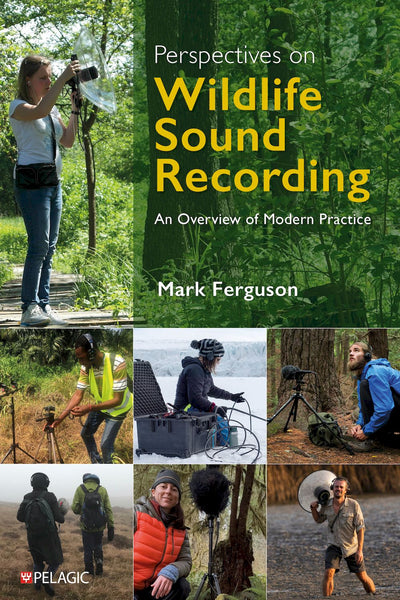





Mark Ferguson talks to us about Perspectives on Wildlife Sound Recording.
Could you tell us a little about your background and where your interest in wildlife sound recording began?
I grew up in rural Northern Ireland, where I spent many happy childhood hours climbing trees and observing birds. For a while, I was a member of the RSPB’s Young Ornithologists Club (now known as the Wildlife Explorers).
Sound became a huge part of my life at the age of eight, when I began learning the violin out of pure curiosity about the physical structure and timbral characteristics of the instrument. One thing led to another, and some years later, I ended up studying Music at Queen’s University Belfast (BMus, 2009–2012), where I developed an interest in field recording, computer music and electroacoustic composition.
It wasn’t until late 2014 (after completing a master’s degree in Electroacoustic Music Composition at the University of Manchester) that I combined my love of the natural world with sound, and began recording wildlife in earnest. Things developed very quickly over the next few years: in addition to embarking on several conservation-based sound recording and post-production projects, I ended up getting a job as a technical support specialist with a microphone windshield manufacturer in south-west England. During my time with the company, I spent every working second learning about professional audio technologies and their real-world applications, making some great friends along the way.
In 2018, I received a scholarship from the Arts and Humanities Research Council to fund full-time doctoral research at the University of Birmingham. There, I combined my passion for wildlife sound recording with studio-based stereo and multichannel composition, building an entire portfolio of works (c. 90 minutes) out of my own wildlife recordings.
Since finishing my PhD, I’ve released three albums, lectured in game audio and film sound design, and been heavily involved in pro audio technical support work. These days, I devote most of my time to recording wildlife around my Northern Irish homeland. I also write books (thanks, Pelagic!) and try to inspire other people about wildlife sounds wherever possible.

The author, taking a break from recording gulls and waders along the Northern Irish coast © Mark Ferguson, 2025
What was the impetus behind Perspectives on Wildlife Sound Recording?
As the title suggests, the main impetus behind the book was to provide a series of curated, up-to-date insights into the wildlife sound recording craft.
I wanted to do this in an inclusive and transparent way, incorporating thoughts and personal stories from a diverse group of practitioners, and covering dozens of different regions and habitats around the world in as much detail as possible. At the same time, I wanted to refresh the published discourse on wildlife sound recording (which is, to be blunt, somewhat dated and thin on the ground), so that the craft could be explored from a community standpoint, rather than through the voice of one person.
It’s the first time a book of this sort—with accompanying sounds, photos and a concise glossary—has ever been published, and I’m very grateful to have been given the opportunity to make it a reality.
You interviewed leading practitioners from all around the world. How do recording methods and fieldcraft vary across different global environments, from the tundra to the tropics?
Wildlife sound recording is a highly specialised variant of field recording: one which focuses on sounds produced by undomesticated species behaving freely within their associated habitats.
Because of the unpredictability of many animal behaviours and the difficulty of recording wild species effectively and responsibly, there are a huge number of craft-specific technical considerations, adaptations and field approaches to take on board. My own methodologies for recording Common Ravens in the Sperrin Mountains with a parabolic reflector, for example, will be very different from making a multichannel habitat recording in southern Arizona; using an unattended rig to record waders in the Banc d’Arguin National Park in Mauritania; or listening to the underwater calls of Bearded Seals in Svalbard (these last three examples are taken directly from the book, by the way).
The remarkable level of specialisation and sub-specialisation within wildlife sound recording is truly fascinating, and having the opportunity to dig even deeper into the methods behind the craft in Perspectives has been nothing short of amazing. The whole project has been a great reminder that even though we use similar technologies as recordists, there are an infinite number of subtle variations on fieldcraft and equipment adaptation/customisation, often built around the very specific requirements of each practitioner and the unique demands of their working environments.

Perspectives on Wildlife Sound Recording covers a huge variety of fieldcraft approaches and recording techniques, including close-miking species using miniature microphones © Mark Ferguson, 2024
Your personal work focuses on the ‘sonic nuances of animal behaviour’, and the ‘audible relationships between humans, wild species and their shared environments’. What is the most important thing you have learned as part of this?
To echo the sentiments of one of the interviewees featured in the book: after a lifetime of listening and observation, I’m struck by how little I actually know about sound, and the living world.
To be honest, I find this tremendously exciting, not discouraging. Time and time again, recording wildlife has made me reevaluate my place in this world and my relationship to other species; it has made me a lot humbler, a lot more respectful. And it has helped me to forge some fantastic friendships along the way, with people who are truly dedicated and devoted to what they do. (The kinds of people who like to get up at 2 a.m. each day throughout the whole spring season, just to listen.)
Of your own time in the field, do any experiences stand out as favourite or most memorable? Have any of these fed into your editing approaches for the book?
I’m very tempted to pick one or two experiences and share them, but I won’t. There are just too many unforgettable moments.
It may seem bizarre to say this as an audio professional, but I think that sound recordists should be wary of overemphasising hearing at the expense of other senses. My time as a sound artist and composer has taught me that the best work often coalesces holistically, taking in a myriad of sensory inputs and emotions along the way. Sound is just one of those ingredients, and it does not—can never—function in isolation in terms of how we perceive the world.
I get the sense that for many of us who take it seriously, wildlife sound recording boils down to the simple moment of listening, with the underpinning intention of putting our own species’ existence in context and sharing more about the natural world in the process. This can’t be achieved through a single act of sonic documentation or by studying any one practitioner, and it is this notion of ‘collective endeavour’ that neatly encapsulates the community spirit in which I approached Perspectives.
To borrow a key concept from scholar, art critic and cartoonist Nick Sousanis, Perspectives is, at its heart, a book that attempts to ‘unflatten’ the practice of wildlife sound recording, unravelling people’s work from many different angles and helping readers/listeners to learn as much as possible along the way.

Mark uses an ultrasound detector to record Common Pipistrelle bats next to a suburban footbridge in Bristol, England © Mark Ferguson, 2021
The book is aimed at both beginners and professionals. What advice would you give to those starting their journey into wildlife sound recording?
As with any other complex and esoteric practice, learning from others is one of the best ways to get to grips with wildlife sound recording. This can be done through reading, listening and practical field experience, in various combinations.
When I started out, I took every opportunity I could to learn about other species, making plenty of informed mistakes and proceeding at all times on the basis of respect. I would say that these three ingredients—learning, willingness to make mistakes, and respect for other species and their habitats—are fundamental to success. Having extreme levels of patience is, of course, a big bonus, but not as important as it might seem: you can achieve a lot with brief, targeted recording trips to select locations, and I know plenty of people who would rather be (slowly and quietly) on the move with a parabolic reflector than waiting for weeks on end to get a single recording.
In terms of audio equipment, it’s impossible to get into any real detail on that here. My general advice is to buy what you can afford and keep it as simple as possible. Better gear will come with experience, and there are so many low-cost options available now that there are very few barriers to making a start.
Then there’s just having fun with it all. If you find that you are truly interested in wildlife sound, that part comes pretty easily.
Order your copy of Perspectives on Wildlife Sound Recording here.