




Sarah Whild talks to us about The Biological Recording Handbook.
Could you tell us a little about your background and where your interest in biological recording began?
I grew up in Wolverhampton in the 1960s, an only child who was quite happy exploring wildlife. An inspirational biology teacher at secondary school helped, and then a truly inspirational botanist, Ian Trueman at (then) Wolverhampton Polytechnic helped to thoroughly ground my love for plants (and animals).

Large-fruited Prickly-sedge Carex muricata subsp. muricata in Shropshire. This
species has no particular legal protection, despite being Nationally Rare.
What was the impetus behind The Biological Recording Handbook?
Well, it's existed in some form as handouts and exercises for students on the MSc Biological Recording, which started at University of Birmingham in 2001 (with a University Certificate in Biological Recording and Species Identification before that, in 1996). There were no text books specifically on biological recording, so it was always a 'one day, perhaps' project to formalise my meanderings!
Professor Paul Ashton described this book as a "distillation of a life’s work". After years as a university lecturer and botanical consultant, what was the most challenging part of condensing that vast knowledge into a single handbook?
Being a jack of all trades, but most definitely mistress of none - all of the different subjects that make up recording, from legislation, geo-referencing, taxonomy, the complexity of organisations involved - it's all rather bewildering. And if it's bewildering for me, then for someone starting out in recording, there surely had to be a way to make it rather more easy to negotiate.

Current data flow situation in many UK counties, with only partial verification for
some data sets and duplication of others.
You define biological recording as a combination of four specific data points: species, location, date, and recorder. While it sounds simple, you mention each has "pitfalls for the unwary". What is the most common mistake you see seasoned naturalists make?
Ah, that's a tricky one. The seasoned naturalists (I'd hope) tend to be pessimistic, so perhaps assume something is the common species rather than the rare one. I'd say grid references are still the most challenging aspect of recording, and understanding that whatever your grid reference is, whatever size, it's still a square.
The book covers the "art of recording," including how to handle absence data. Why is knowing what isn’t there just as important for conservation biology as knowing what is?
I'm not sure we can ever really know that something isn't there, just that it has not been found. Tiny gemmules of bryophytes, invertebrate eggs, sneaky mammals and birds - they can all catch us out. Although I'm reasonably certain there are no elephants in the room as I'm writing this...

Large Blue butterfly Phengaris arion © Amanda Craig
You invite readers to consider the future of biological recording. With the rapid advancement of AI-assisted identification and remote sensing, do you think the role of the individual "named recorder" is becoming more or less vital?
This is a truly significant area in recording right now. The 'who' part of a record is, in my opinion, the most important part, as it gives the record its authority, its gravity (or lack thereof!). AI assisted identification could be an incredibly useful adjunct to traditional biological recording, but I think that the two disciplines together can provide a powerful tool for making conservation decisions. And at the end of the day, this is why we make records and use them, so we know what there is, and where.
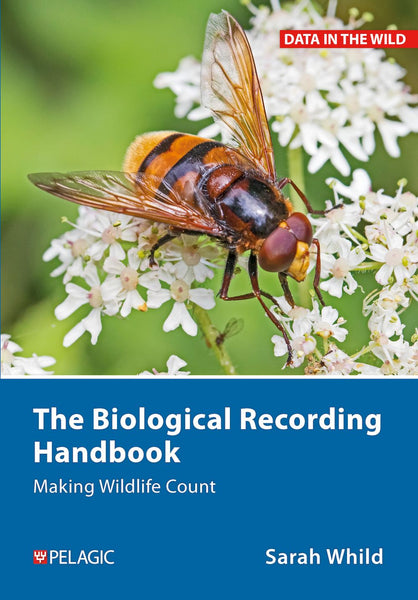
Order your copy of The Biological Recording Handbook here.