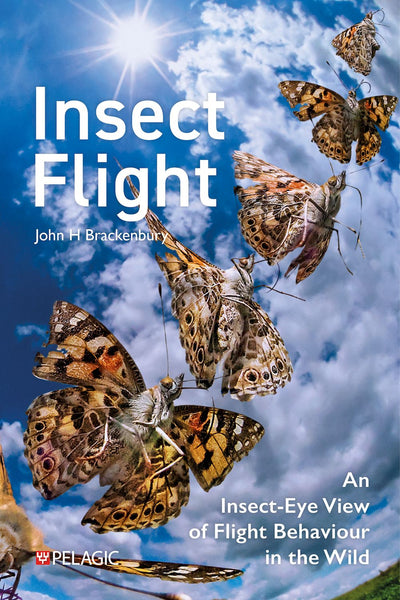





John Brackenbury talks to us about Insect Flight.
Could you tell us a little about your background and where your interest in insect locomotion began?
I studied Zoology at university and even though my subsequent career took me into teaching veterinary medicine, I always harboured a fascination with insects. By good fortune, in the latter years of my time at university, I found an opportunity to carry out research into the biomechanics of locomotion in insects.
You have long been recognised for your work with insects in controlled settings, but this book marks a significant move into the hugely more challenging task of capturing them in the wild. What was the primary catalyst for leaving the studio behind?
My 'studio' was in fact a large canvas tent, open at both ends, erected in a field in the Picos mountains of Spain, an area very rich in insect species. I had designed a system for photographing insects soon after take-off using a high-speed flash discharge triggered by a laser-beam. The beam was arranged across the inside of the tent, and I would release insects from one end. Attracted by the light at the other end, they would fly towards it and hopefully intercept the beam. It was very hit-and -miss with a very low success rate; nevertheless, it generated a lot of highly detailed information on the way wings behave during flight.

© John Brackenbury
What were the greatest technical hurdles you faced when capturing images in the field?
Photographing insects in the wild was far more challenging. I realized that the insects would not come to me, I would have to actively come after them. Moreover, the imagery would have to be captured using natural light and a hand-held camera. I also wanted to photograph them in an unconventional way: not as macro images isolated from their background but as 'figures in the landscape'. This required immense depth of field and needed a lengthy period of research before I arrived at the optical solution. However, the main challenge was not technology but learning how to develop the field craft needed to get the camera lens within a few centimetres of the insect. I began to appreciate the importance of peripheral vision when trying to capture something moving at speed in the corner of your eye! Curiously and unexpectedly, I found the experience of having played competitive squash for many years came in very useful: reacting to the trajectory of a tiny ball whizzing past. Instead of racket think of camera and the analogy is very close. Events happen very quickly; if you spot an opportunity, there is no time to compose. This means shooting 'blind': a skill that required a very lengthy apprenticeship!

© John Brackenbury
Were there any specific flight manoeuvres you captured that particularly surprised you or challenged existing aerodynamic theories?
At this stage I was far more interested in flight as an expression of behaviour than simply a biomechanical event. The real breakthrough for me was when I started using a high- speed video camera; after all, behaviour is a dynamic sequence of events in time. Very rapid behaviour in the case of a flying insect. I have now recorded many events that are new to me and in some cases to science in general, especially unexpected escape mechanisms, invisible to the naked eye. But also, the sheer inventiveness of many of the flight manoeuvres, testifying to the 'intelligence' of creatures with a brain possessing no more than a million neurones.
Critics have described your work as transforming insects into "objects of art". Do you view yourself primarily as a scientist documenting data, or as an artist capturing a "miracle of biological engineering"?
Art versus science. The camera for me has always been a tool for investigation. If at the same time I can photograph my subjects in a way that is aesthetically appealing, then that is a bonus. To my critics I would say: assess an image not only on its pictorial merits but also on what it tells you about the life of the insect.

© John Brackenbury
What advice would you give someone looking to start their journey in wildlife photography?
There are certain essential technical 'rites of passage ' for anyone setting out to do wildlife photography. Just getting a satisfactory in - focus image is difficult enough, though things are made much easier with modern autofocus cameras. With insects, nothing beats a camera phone for achieving macro images. It is light to handle, demands next to no technical skills and gives very acceptable results, certainly for display on the computer. In contrast, it is less suitable for telephoto shots and bird photographers require better quality equipment. At the end of the day, though, the chief requirement is patience. Animals in general have no interest whatever in trying to make life easy for you.
Learn more about Insect Flight here.