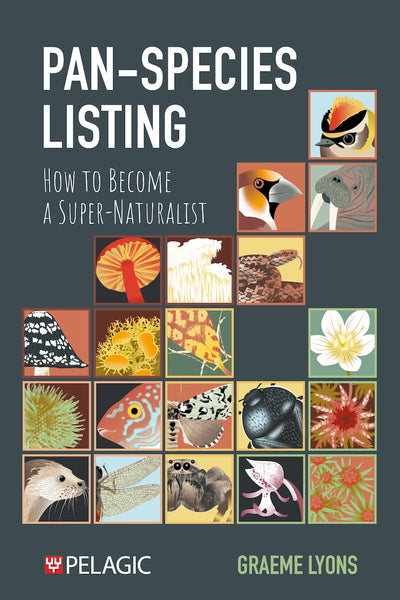





Graeme Lyons talks to us about Pan-Species Listing.
Could you tell us a little about your background and when your interest in biological recording began?
I grew up below the poverty line in a mining town in Staffordshire and had a difficult start in life, but I was at least exposed to lots of nature with Cannock Chase within walking distance of my house. I made my first biological record in 1988 around age 10 but it was a chance encounter with a Goldfinch when I went a walk with my gran age 5 that initiated my first 'picture matching' session in a field guide. I was hooked!

An early encounter with an owl.
As a founding member of the pan-species listing movement, could you outline how it differs from existing methods of recording?
Well, it's not really an alternative to recording, more an alternative to keeping a life list of (just) birds - but with huge emergent benefits to recording that come from this. At its most simplistic, it's the gamification of natural history by opening up the goal posts so wide that every taxonomic group (not just birds) counts as a tick. So you can forget the 500 club and say hello to the 10,000 club! Everything is a lifer now, from a beetle hand-caught in the park to a gall spotted on my way to the shops - instead of getting three or four lifers a year, I average over one new species a day!
Who is the target audience for Pan-Species Listing?
Anyone can get involved in pan-species listing - the website is totally free. I wrote the book to appeal to lots of different people; from the hardcore to natural to the casual beginner. Of course, I want to find all those 1 in a 1000 bright young naturalists and channel them towards PSL most of all, but it will work for anyone at any stage in their life or career. If you don't want to get involved with PSL, there's loads of useful information for any naturalist. The large chapter that makes up half the book tells you how to get into every obscure branch of British natural history you could ever think of. It's also full of anecdotes and is in part a biography of the interesting life I have had. Furthermore, the chapters on neurodivergence, representation, AI and more should appeal to many.

The Pan-Species Listing website.
What was the biggest challenge you faced whilst working on the book?
Imposter syndrome. It was crushing for the first two years, only starting to ease off after I had sent my first draft off to the publishers. Writing about areas I knew well was easy but researching other areas made me feel like a fraud - my only way around this was to throw myself into these areas or in a few cases where I had zero experience, get help from others (especially Brian Eversham).
You’ve recently shared your diagnosis of being both autistic and ADHD. In what ways has your neurodivergence influenced you as a biological recorder?
Well it's certainly why I am so driven/focused and have clocked up over 360,000 records but it's important to recognise it's not all rosy. Away from natural history and work, many areas of my life are chaotic and unpredictable and I tend to forget about things, which gets me into trouble with friends, family....and utility companies.

Calosoma sycophanta
With over 38 years of recording and a personal tally of 9,778 species in the UK, are there one or two sightings that still stand out as the most rewarding or unexpected?
I usually answer this with "whatever I saw last" but as it's nearly ten years since I found the incredibly rare and rainbow coloured Calosoma sycophanta in an arable field in East Sussex, I still think that's the one I'll never forget or repeat. Last year was one of the best years of natural history I have ever had, with the first discovery of the spider Aulonia albimana in the UK in 40 years on the Isle of Wight was pretty unbeatable and just missed going in the book - especially as it led to me doing BBC Breakfast a month later.
Order your copy of Pan-Species Listing here.