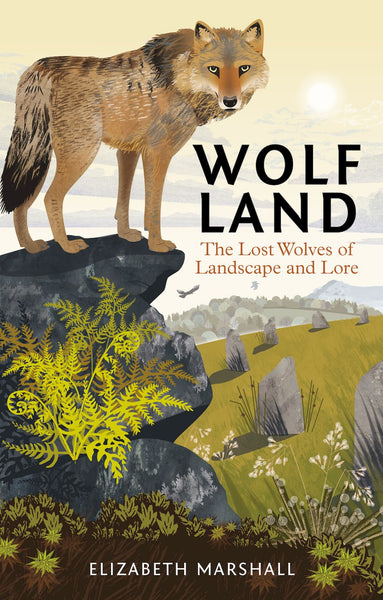





Elizabeth Marshall talks to us about Wolf Land.

Could you tell us a little about your background and where your interest in wolves began?
I wish I had a gripping story of a formative first encounter with wolves, but my interest grew over time rather than being a deep-seated passion from long before adulthood. I don’t actually remember much about what I thought of wolves as a child. Like most, I encountered them in fairy tales demolishing the houses of innocent little pigs or tricking a little girl in a red cloak – characters which I suppose I didn’t think much about at the time.
Wolves eventually became the topic of my doctoral research, mostly due to chance. I was in the middle of my master’s in mediaeval English and was casting about for a topic for my PhD. I knew that I wanted to study something to do with monsters or animals in Old English literature. On the advice of one of my tutors, I went away to do some reading and came back with a list of possible topics. Wolves was one of them. Of all the weird and wonderful creatures that tread the manuscripts of early medieval England they were some of the least well studied, so it was an easy decision – though I couldn’t have imagined just how consequential it would be.
It was quite some time before I saw a wolf in the flesh. I hadn’t really considered them as beings in their own right until then – they were characters in the poems I was studying or mere metaphors for evil people. But when I finally came face to face with a pack of three North American grey wolves at the Scottish Deer Centre in Fife, I was captivated. Wolves have such a unique way of looking at you. It feels as though they’re really seeing you and contemplating you, that they are having thoughts about you just as you are having thoughts about them.
Not long after that, I received funding to do a doctoral internship which allowed me to spend time with that same wolf pack. I observed them and documented their behaviour, and when I wasn’t doing that, I was researching everything to do with wolves, from their behaviour to their ecological role, their place in modern culture and the issues surrounding their reintroduction to Britain and Ireland. I credit those wolves in Fife with showing me what their kind truly is – I suppose my first meeting with them was my formative first encounter.
With a background rooted in academia, what made you want to transition from purely academic writing to sharing this broader history with the public?
It’s partly a product of a deep-rooted desire to see wolves return to Britain and Ireland, and partly due to a frustration that wolves are so misunderstood. Knowledge is the single most important thing when it comes to getting the public on board with wolf reintroduction, so it’s crucial that research and information do not just stay within the academic realm, particularly when wolves are the product of such vociferous misinformation.
But the more I dug into it, the more I realised just how little readily available information about wolves in Britain and Ireland there was, aside from a chapter in a book written by a Victorian antiquarian called James Edmund Harting, which itself was full of misinformation and myths presented as fact, and which would hardly be read by anyone who didn’t intentionally seek it out. What we do hear about wolves in Britain and Ireland is usually via documentaries, which aren’t always as impartial towards wolves as I might like, or via the press, which often sensationalises stories of wolves in other countries.
I hope that Wolf Land brings the true history of Britian and Ireland’s wolves to a much wider audience, and provides an antidote to the misinformation and mythmaking that is so prevalent in the discourse around wolves.
You track the wolf through archaeology, literature, religion, and folklore. In your research, what did you find to be the single biggest misconception or "misguided myth" that British and Irish cultures created about wolves?
There are so many to choose from! The ones that I find most amusing are the numerous legends that the last wolf in Scotland (or in certain regions of Scotland) was killed by a grumpy old Highlander with a frying pan. Another story of the ‘last wolf in Scotland’ is a stirring tale of a 7-foot-tall tartan-clad warrior who beheads a gigantic black beast that was eating children. These are myths that somehow get repeated as fact, despite having all the hallmarks of folklore.
But I think the biggest lie is the idea that wolves have no place in our landscapes. Ever since we developed the idea of the ‘green and pleasant’ ‘chocolate-box’ countryside, there has been a conception that wolves simply do not belong in Britain and Ireland – that there’s no ‘wilderness’ left for them or not enough space. It’s certainly true that wolves couldn’t live everywhere, and that living alongside them would – to say the least – be a big adjustment. But several academic studies have used modelling to identify parts of Britain and Ireland where wolves could successfully be reintroduced, while the example of European wolf populations (which often live in areas of very high human density) show that reintroducing wolves here is not the fantasy that many believe it to be.
Wolves are deeply woven into our cultural lives. How difficult was it to separate genuine historical fact from the ubiquitous fiction surrounding them?
Humans are the most unreliable narrators for the wolf’s story – we invent things about both wolves and about what people throughout history have thought and felt about them.
Sometimes, it was extremely difficult for me to ascertain what was factual and what was false, especially when digging through sources such as Harting, who repeats information from older sources that are now incredibly difficult to find. On more than one occasion, I ended up on a wild goose chase hunting for the source of a piece of information that probably wasn’t true in the first place, but that I couldn’t reach a verdict on without more information. There are also ‘facts’ that seem as though they could be true, but are extremely difficult to find evidence for. Claims about Celtic beliefs surrounding wolves are some of the most difficult to verify because they are a people that we tend to mythologise but about which we know comparatively little, especially in terms of the specifics of their spiritual beliefs, which almost certainly varied between regions given how widespread the Celts were.
At other times I was incredulous – and irritated! – at the regularly regurgitated ‘facts’ that are quite obvious fabrications, like the stories of the ‘last wolves’ found throughout both Britain and Ireland. At some point you have to consider that if only one of these stories can possibly be true, in all likelihood, none of them are.
Praise for your book highlights it as a "heartfelt plea to see wolves as they truly are." Was there a specific moment or discovery during your research that transformed this project from a historical chronicle into a personal mission to rehabilitate the wolf’s image?
To bring up Harting once again, one of the key moments was when I read his chapter on wolves in British Animals Extinct Within Historic Times. I realised then how few truly impartial accounts of British and Irish wolves there were, and just how many lies, myths and legends have been spread over the centuries. Almost 100 pages-worth of them, in fact.
Garry Marvin’s Wolf was also an influential and at times difficult read. He doesn’t shy away from telling the brutal stories of how wolves in North America were tortured and killed both because of conflict with humans but also because of the cultural beliefs that people held about them. When you see the same vitriol and vehement hatred circulating online today (epitomised by the phrase “shoot, shovel, and shut up” among the anti-wolf contingency who despise living alongside wolves, particularly in America), it’s hard not to become emotionally invested in trying to do something to change the narrative.
When you become attuned to the dialogue about wolves, it also becomes painfully clear just how powerful and ubiquitous these misconceptions are. You quickly realise that when wolves are mentioned in books, films or TV shows, whether in literal or metaphorical terms, it’s almost always in a negative light, and that when people you know make jokes about wolves eating children, they are only partly speaking in jest. Knowing the truth about wolves – that they are nothing like their reputation suggests, but that throughout history they have been murdered and mutilated for this reputation, and that they still are today – made me want to do whatever I could to help rehabilitate their image.
The final part of Wolf Land looks at the unwritten future and the concept of rewilding. Given your expertise in wolf ethology and ecology, what do you see as the biggest ecological or cultural hurdle to bringing wolves back to Britain and Ireland today?
Studies have shown that there are enough available habitat and prey for a viable population of wolves, so ecology is not the main issue. The main hurdles will be cultural and sociological. Rewilding and the reintroduction of predators are delicate and incredibly complex issues, and local people must be at the heart of any wolf reintroduction because it is ultimately these communities who would have to live alongside them. But aside from the problems of adapting to live with wolves (of which there are certainly many – although none, I would argue, that are insurmountable), one of the biggest barriers will be misconceptions and fear of the unknown. Wolves as an object of fear are deeply ingrained in our culture and in our minds. Fear begets falsehoods, falsehoods beget fear, and both result in dead wolves and a failed reintroduction.
If we want to bring wolves back, we must change the narrative, transforming wolves from the big bad monsters of our childhood stories to animals that belong within the ecosystems to which they are native, no more or less than any other species.
Order your copy of Wolf Land here.