





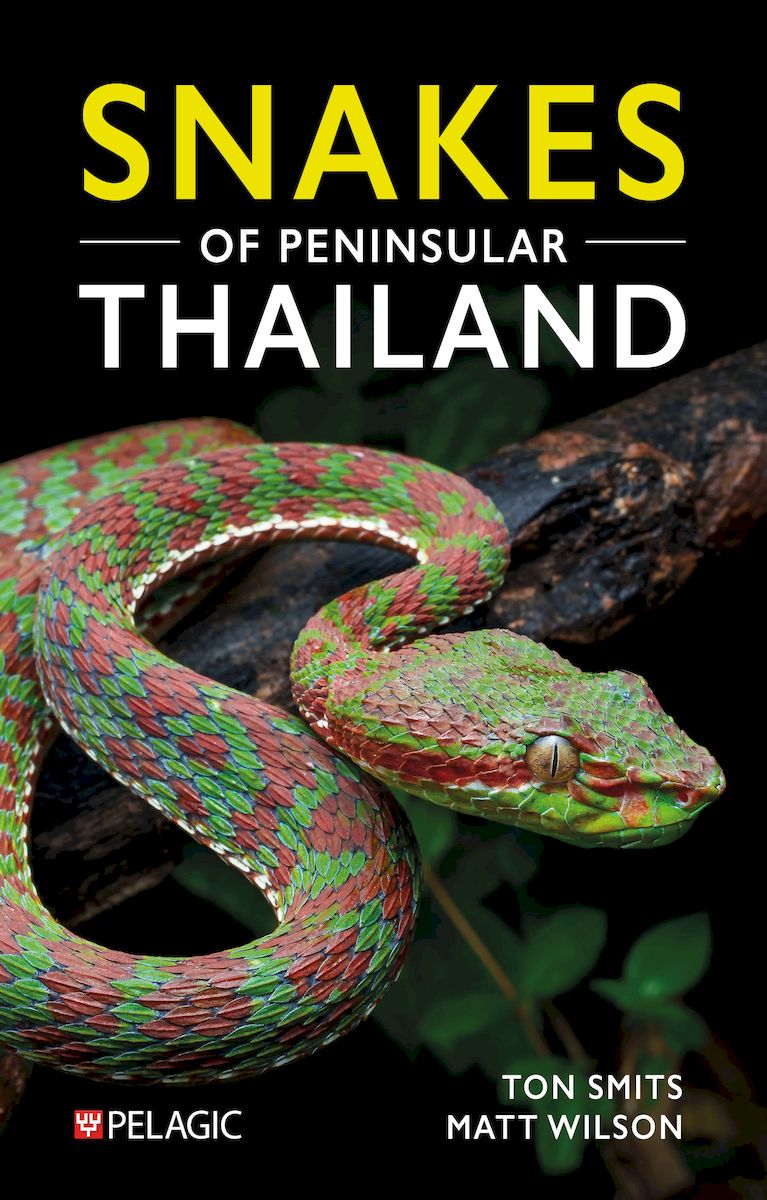


Snakes of Peninsular Thailand
- Detailed information on 190+ snakes of southern Thailand.
- More than 700 dazzling photographs, as well as up-to-date distribution maps.
- Direct comparisons between highly venomous snakes and their harmless mimics.
- Coming Soon
- herpetofauna
- herpetology
- identification
- reptiles
- snakes
- Thailand
Related Books


Description
This stunning photographic guide covers more than 190 snake species found across peninsular Thailand, including Phuket island and other popular tourist destinations. Each species description contains essential identification information, with a special focus on how to differentiate dangerous snakes from their harmless lookalikes. There is detailed discussion on distribution, with a separate map covering Phuket island, as well as notes on habitat, the likelihood of encountering each species, as well as whether or not the snake is a potential danger to humans.
Illustrated with over 700 photographs, this beautifully designed book also offers:
- an overview of snake biology
- identification plates for less commonly encountered sea snakes
- a chapter on conservation and threats to snakes on Phuket island
- what to do in case of snakebite
- advice on how to deal with a snake near your home and, for those who are less comfortable around these animals, some tips on how to make your garden less attractive to snakes
- a beginner’s guide to herping (how to find snakes)
- an exploration of the sorts of environments where snakes live
- fascinating notes and anecdotes from the field.
As well as being suitable for dedicated field herpetologists, this is also a perfect introduction for local residents and visitors with little knowledge of these compelling reptiles.
DOI: 10.53061/FIWX1845
Reviews
- Ton Smits and Matt Wilson are to be congratulated on producing a profusely illustrated and fascinating field guide. Its greatest strength is the detailed information about species identification and the background bio-ecology of the snakes of Peninsular Thailand. The book’s authority derives from the authors’ intensive field work and observations made in a very attractive part of the world that is popular among foreign tourists. I hope that the book encourages a more sensitive, humane, and conservationist attitude toward the diverse snake fauna of the region.
—Professor Sir David Warrell, University of Oxford, UK - A comprehensive and up-to-date guide to the snakes of Southern Thailand, filled with fascinating natural history insights and outstanding photographs. An indispensable resource for any herpetologist or wildlife enthusiast interested in Asian snake diversity.
—Parinya Pawangkhanant, Rabbit in the Moon Foundation, Thailand - Featuring excellent photographs, this field guide will serve as a reference for future generations. The authors—experts on Thailand’s snake fauna—have painstakingly gathered a vast amount of data on the species inhabiting southern Thailand. The illustrations are a visual delight. This work deserves a place in the library of anyone interested in snakes.
—Gernot Vogel, herpetologist, Germany - In this book, the authors have managed to combine absolutely everything one could hope for in a regional guide: vast amounts of useful information for seasoned herpers and novices alike, breathtaking photography, wonderfully illustrated identification tips, and all of it packaged in a highly accessible format that makes picking up this book an absolute pleasure. This book has set a new standard for others to aspire to!
—Professor Wolfgang Wüster, Bangor University, UK
About the Author
Ton Smits was born in Holland. His childhood passion for herpetofauna and later wildlife photography took him across the world. In 2009 he moved to Thailand and started Tontan Travel, a wildlife and herping tour business. He has coauthored several scientific publications on Thai snakes, including a new viper species.
Matt Wilson works in international education and was formerly a herpetologist at the University of Manchester, the Manchester Museum (UK). He has written numerous scientific papers on reptiles and amphibians in Europe and has contributed to the knowledge of herpetofauna in Europe, Africa and S-E Asia. As well as having a passion for amphibians and reptiles he also enjoys bird and mammal watching. When not teaching internationally, he spends time at home in the UK and Slovakia.
Bibliographic Information
 300 pages
 - 700 colour photos and distribution maps for all species.
- BISAC SCI070010, NAT028000
- BIC PSVW5, WNCK, 1FMT
